Megaways Slots: How They Differ from Classic Slot Machines
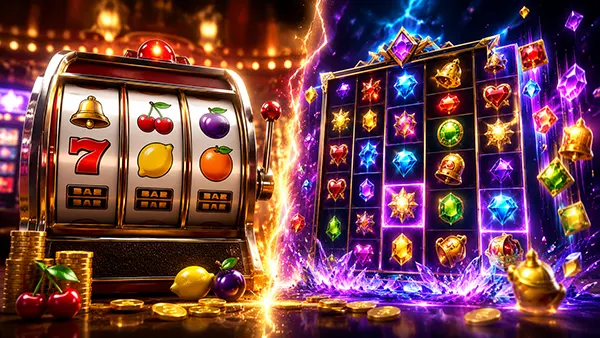
Megaways slots use a changing reel layout rather than the fixed grid found in most traditional slot machines. The number of symbols shown on each reel can alter from one spin to the next, so the number of possible winning combinations changes as well. This makes the screen less predictable without changing the basic principle of a slot: a player selects a stake, starts a spin and receives a result generated by a random number generator. The format was created by Big Time Gaming and has since been licensed to other developers, which is why games with very different themes may share the Megaways name. As of 2026, the mechanic remains widely used in online slots, but the logo alone does not reveal a game’s return to player, volatility, bonus frequency or maximum payout. Those details still need to be checked in the individual rules.
How the Megaways Reel System Changes Each Spin
A classic slot normally keeps the same arrangement throughout play. An older-style machine may have three reels and a small number of fixed paylines, while a modern video slot often uses five reels with ten, twenty or more predetermined lines. The symbols change after each spin, but the number of visible positions usually stays the same. A Megaways game takes a different approach. Each reel can display a variable number of symbols, commonly between two and seven, depending on the title. When several reels expand at the same time, the grid becomes much larger; when fewer symbols appear, it contracts. The visual change is immediate, and the game recalculates the available ways to win for that result.
The well-known figure of 117,649 ways comes from a six-reel layout showing seven symbols on every reel: 7 × 7 × 7 × 7 × 7 × 7. That is a maximum used by many Megaways slots, including Big Time Gaming’s Bonanza and Max Megaways, but it is not a universal rule for every title. Some licensed adaptations use fewer positions, additional reels or other arrangements, so their advertised total may be lower or higher. The key point is not the headline number itself. What defines the format is the random reel modifier, which changes the number of symbols and therefore the number of possible combinations on each spin or reaction.
This changing structure affects how the game feels, but it does not mean that a spin with more ways is automatically profitable. A large grid creates more possible symbol routes, yet the value and frequency of those symbols are already built into the game’s mathematical model. The stake normally covers all active ways, so players do not select hundreds of thousands of separate paylines. In a fixed-line slot, increasing the number of enabled lines may increase the total cost unless the stake per line is reduced. In a Megaways slot, the displayed stake is generally the total cost of the spin, while the number of ways is generated by the reel configuration.
Winning Ways, Cascades and Reel Height
Most Megaways wins are formed by matching symbols on adjacent reels, starting from the leftmost reel. A symbol may appear in any visible position rather than on a drawn payline. For example, if the same symbol lands twice on reel one, three times on reel two and once on reel three, those occurrences can create several separate ways for the same winning combination. The exact payment is determined by the game’s paytable and the number of matching reels. Scatter symbols usually follow different rules and may pay or trigger a feature wherever they appear. Because developers can modify the standard formula, the information panel should always take priority over assumptions based on another Megaways game.
Cascades, also called reactions or tumbles, are common but are not the same thing as the changing reel height. After a win, the contributing symbols are removed and new symbols fall into the empty spaces. If the replacement symbols create another win, the process repeats without charging for a new spin. Some games keep the reel configuration during the full cascade, while others apply their own rules. Cascades can make one paid round last longer and can produce several awards, but many spins still end without a cascade because no initial win is formed. The feature changes the sequence of play; it does not remove the house advantage.
Current games show how widely the mechanic can be adapted. Bonanza uses six main reels, up to 117,649 ways and reaction wins, while Pragmatic Play titles such as The Money Men Megaways can show as many as seven symbols on a reel and remove winning combinations to continue a chain. Blueprint Gaming’s Fishin’ Frenzy The Big Catch Megaways uses six reels with up to five positions on each reel, proving that a licensed Megaways slot does not have to copy the seven-symbol maximum. The Dog House Megaways 1000, released by Pragmatic Play in 2026, combines the familiar variable grid with multiplier wilds and a stated maximum of 117,649 ways.
Gameplay Differences Players Notice Most
The most obvious difference is variation from spin to spin. A classic five-reel game presents a stable grid, so it is usually easy to see where paylines run and how many symbols are needed. Megaways screens may expand, contract and refill several times during one paid round. This can create a faster and busier presentation, especially when cascades, sound effects and changing counters operate together. The added movement does not make the result less random or more controllable. It simply presents the underlying outcome through a more changeable layout. Players who prefer a calm, easily read screen may find a fixed-grid slot more comfortable.
Bonus rounds also tend to be more layered. In many Megaways games, free spins are combined with a multiplier that rises after each successful cascade. Others add expanding reels, mystery symbols, symbol upgrades, collected modifiers or several bonus choices. These features are not compulsory parts of the Megaways system, and two games carrying the same trademark can behave very differently. A classic slot can also include free spins, multipliers and bonus games, but its features are often built around a fixed set of reels and paylines. The distinction therefore lies in how the bonuses interact with the variable grid rather than in the mere presence of a bonus round.
The pace can influence staking decisions. A single Megaways spin may produce several cascades, which can make it feel as though more rounds have been received for one wager. In practical terms, however, the player paid for one initial spin and the cascade sequence is part of that result. Fast-play controls and automatic spinning can reduce the time available to notice how quickly the balance is changing. The sensible comparison is the cost per paid spin and the number of paid spins made in a session, not the amount of movement on screen. Setting a fixed spending limit and avoiding attempts to recover losses remain relevant with both Megaways and classic slots.
RTP, Volatility and Maximum Win Explained
Megaways is a reel mechanic, not a fixed return-to-player setting. RTP is the theoretical proportion of stakes that a particular version of a game is designed to return over a very large number of rounds. It does not predict the result of a session, and it can vary between games or between approved configurations of the same game. Some developers provide operators with several RTP versions, so two sites may offer visually identical releases with different percentages. The correct figure should be shown in the game information or help menu. A high number of winning ways cannot be used as a substitute for checking that value.
Volatility describes the general pattern of payouts. Many well-known Megaways games are rated medium-high or high volatility because a significant part of their potential is concentrated in cascades, free spins and multipliers. This can produce long periods of small or absent returns between stronger feature rounds. The pattern is not universal, but players should not assume that more combinations mean frequent substantial wins. A classic slot can be equally volatile, particularly if it offers jackpots or large multipliers. The useful comparison is the provider’s stated volatility, the paytable and personal experience in demo play, where legally available, rather than the reel format alone.
Maximum win figures also need context. A game may advertise a limit expressed as a multiple of the stake, such as 5,000x or 25,000x, but that is a ceiling rather than an expected outcome. The cap may apply once total winnings in a round reach the stated amount, and the rules may end the feature at that point. Different Megaways titles have very different limits, just as classic slots do. The presence of 117,649 possible ways does not mean 117,649 awards can be collected on a spin, nor does it show the probability of reaching the maximum. Only the official rules describe how prizes, multipliers and payout caps work.
Choosing Between Megaways and Classic Slots
The better format depends on what a player values in a game. Classic slots are usually easier to read because the number of reels, rows and paylines remains fixed. They suit people who want to understand the screen quickly and prefer a consistent rhythm. Megaways slots provide more visual variation and often make bonus sequences more elaborate, but their changing counters and cascades can require closer attention. Neither format offers a reliable way to win, and neither is automatically more generous. Both are games of chance with a built-in house edge, so the choice should be based on entertainment preferences rather than an expectation of income.
Before selecting a title, it is worth reading the paytable instead of judging the game by its theme or headline number. The rules should explain the minimum and maximum stake, how winning combinations form, whether wins must begin on the first reel, how wilds and scatters behave, what triggers free spins, whether a multiplier resets, and when a maximum-win cap applies. It should also show the RTP where required and may provide a volatility rating. In a Megaways game, players should check the actual maximum number of ways because the familiar 117,649 figure is common but not guaranteed.
It is also useful to separate the core Megaways mechanic from optional extras. Bonus Buy, ante bets, enhanced spins and feature-selection menus are separate functions that may raise the stake or change the game model. Their availability depends on local law and the version supplied by the operator. A game can still be a Megaways slot without any of these controls. Classic slots may offer similar paid features. Before using one, the player should check the exact price, the displayed RTP for that mode and whether the higher immediate cost fits the session limit. Skipping a paid shortcut does not prevent the base game from producing its normal random results.
Practical Checks Before Playing in 2026
Use only a gambling site authorised for the player’s location, and confirm the legal age requirement before opening a real-money account. A legitimate site should identify its operator and regulator, provide access to the game rules and display tools for deposits, losses, time-outs and self-exclusion where local rules require them. The game itself should name the developer and provide an information screen. Megaways is a trademarked mechanic licensed by Big Time Gaming, but the trademark does not replace regulation of the operator or certification of the individual game in a particular market.
A practical session plan is simple: decide the maximum affordable loss, choose a stake that allows enough spins without exceeding that amount, and stop when the money or time limit is reached. Cascades, near-misses and expanding reels can make a session feel eventful, but they do not signal that a bonus is due. Previous results do not make the next spin more likely to win because each paid round is generated independently under the game’s rules. Gambling should never be treated as a method of paying bills, building savings or recovering earlier losses. Anyone finding it difficult to stop should use the site’s blocking tools and seek local support.
In 2026, the clearest difference remains structural. Classic slots normally keep a fixed grid and fixed paylines or ways, while Megaways slots alter reel height and recalculate the possible combinations for each spin. Cascades and progressive multipliers are common additions, but they are not guaranteed, and the mechanic does not determine RTP, volatility or maximum win. Reading the individual rules is therefore more useful than relying on the Megaways label. Players who value simplicity may prefer classic games; those who prefer changing layouts may favour Megaways. In both cases, the outcome is random, the house retains an advantage and spending limits matter more than the number shown above the reels.